









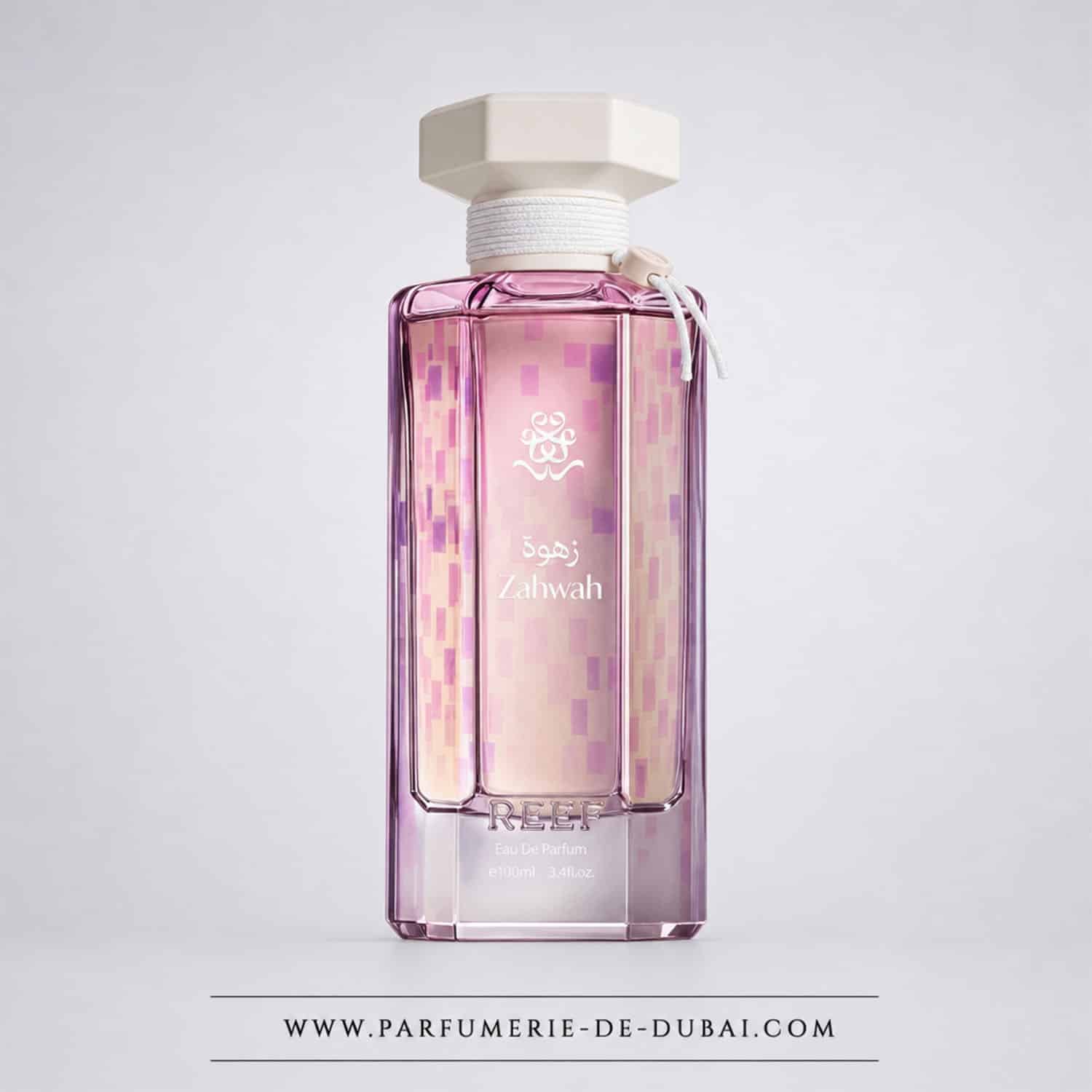
Zahwa
Floral-amber eau de parfum for men and women · lavender, saffron, elemi, hazelnut, Bulgarian rose, sambac, resins, jasmine, labdanum, amber, ambrette, sandalwood, ambroxan, osmanthus, and vanilla
An aromatic and spicy top note, a heart of white flowers and Bulgarian rose, followed by a base note where seven amber and woody notes take over.
Zahwa by Reef Perfumes: an eau de parfum that ranges from lavender to sandalwood, with notes of Bulgarian rose
Created by Reef Perfumes, Zahwa is a unisex eau de parfum launched in 2026, available in a 100-ml spray bottle and listed by the brand as RP180035. Its fragrance pyramid features fifteen notes: lavender, saffron, elemi, and hazelnut on top; Bulgarian rose, sambac, resins, and jasmine at the heart; and labdanum, amber, ambrette, sandalwood, ambroxan, osmanthus, and vanilla on the base. The composition is credited to Émilie Bouge, senior perfumer at Takasago. The name comes from the Arabic word “zahwah,” which refers to beauty, freshness, and a vibrant young plant. The brand does not publish olfactory families or accord classifications, and no community ratings are currently available for this fragrance. Available as an authentic product at Parfumerie de Dubai.
A pyramid that tilts toward the bottom
The first notable feature of Zahwa is its distribution: seven out of fifteen are placed in the background. A pyramid that widens as it descends rather than narrowing foreshadows a fragrance whose essence unfolds after the first half-hour. The four top notes are not merely a decorative prologue, however: lavender, saffron, elemi and hazelnut create an aromatic, spicy, and slightly toasty opening that is unlike any citrus-based opening.
Combining lavender with saffron is an unusual choice. The former is fresh, camphor-like, almost medicinal; the latter is leathery and dry. Between the two, the’elemi, a resin from the Philippines with notes of both lemon and incense, serves as a bridge. The hazelnut adds a toasty roundness that keeps this trio from feeling austere. It’s a perfumer’s opening, not a marketing brief’s opening.
The heart note evokes the most classic elements of perfumery. The Bulgarian rose and the jasmine sambac, cited here in both forms, are the most widely used floral pairing in the world, and the resins The elements accompanying them ensure the transition down the pyramid. This center is not meant to surprise; it is there to connect an unusual top with a very busy bottom.
And this background is the real focus. Seven subjects work toward the same goal without overlapping: the labdanum and theamber For warm and resinous woods, the’ambrette and theambroxan for musk and mineral notes, the sandalwood For lactic acid, the’osmanthus For a hint of apricot and leather, the vanilla for the final touch of sweetness. Four of them belong to the amber family in the broadest sense, which sets the tone for the fragrance.
Among the other new features this season, Echoes of St. Moritz offers the exact opposite: a perfume extract from another brand, with a cool, aromatic, woody profile built around cypress and moss. There is no connection between the two brands, and the comparison is limited to the scent profile: one evokes mountains and greenery, while Zahwa evokes flowers and amber.
Zahwa Promo Code
To discover Zahwa at a reasonable price, use the coupon code Dubai10 and enjoy -10% discount on your order.
What the Name Means
Zahwah, in Arabic, has several similar meanings: beauty, freshness, a beautiful view, and the image of a vibrant young plant in use. The word belongs to a family of terms associated with radiance and fulfillment, and it is also used as a female given name in the Arab world.
The pyramid captures the essence of the fragrance better than one might think. Bulgarian rose, sambac jasmine, and osmanthus provide the floral and radiant notes that give the fragrance its name; the amber base note adds warmth. The brand has not released any statement explaining its choice, and we are not making any assumptions about it: we are simply connecting two verifiable pieces of information—the meaning of the word and the list of ingredients.
Olfactory pyramid
Fifteen notes, divided into four top notes, four middle notes, and seven base notes. A vocabulary note for reading this list: resins is a generic term that does not specify any particular ingredient, and we are quoting it as is without attributing any specific identity to it. The official Reef Perfumes product description, for its part, provides only a three-word summary, which we discuss further in the FAQ.
The Three Stages of Composition
This three-part analysis is based on the published pyramid, not on a ranking of wearers: Zahwa does not have any community profiles listing agreement votes, nor does the brand publish any. We therefore describe what these ingredients are in perfumery, without claiming to know the exact proportions in which they are blended.
Product sheet
How to Wear It
Reef Perfumes Zahwa FAQ
Why does the house listing mention cinnamon?
Because it sums up the fragrance in three words—cinnamon, musk, and amber—whereas the detailed fragrance profile lists fifteen. Two of these three words are easily identified: amber corresponds to labdanum and base notes of amber, and musk to ambrette and ambroxan. Cinnamon, on the other hand, does not appear in the detailed list. We present both pieces of information rather than omitting one, and we do not speculate on the reason for this discrepancy.
Who is Émilie Bouge?
A French perfumer from a family in Grasse whose history in perfumery dates back about two centuries. Trained at ISIPCA in Versailles, she began her career at LMR and then at Charabot—which was later acquired by Robertet—where she helped establish the Indonesian laboratory. She joined Takasago as a senior perfumer in Paris in April 2025. Her notable creations include Carmina and Centaurus for Creed, Torino 21 and Torino 22 for Xerjoff, Buongiorno for Acqua di Parma, Black Datura for Miller Harris, and Blu and Shiro for Ajmal.
What does the name Zahwa mean?
Zahwah is an Arabic word with several closely related meanings: beauty, freshness, a beautiful view, and the image of a young plant bursting with vitality. It is also used as a female given name. The company has not published any text explaining the connection between this name and the fragrance.
What is the difference between amber, ambrette, and ambroxan?
Three distinct subjects, despite their common root. The’amber In perfumery, this is a fragrance accord—a blend built around labdanum, benzoin, and vanillin—that has a warm, powdery quality. The’ambrette is a plant seed with a natural, sweet, and slightly fruity musky scent. The’ambroxan is a synthetic molecule with a mineral, dry, and very radiant character that has become one of the most widely used base notes in contemporary perfumery. All three coexist here in the same base note.
What is labdanum?
It is a resin harvested from the rockrose, a Mediterranean shrub whose leaves secrete a sticky gum when exposed to heat. Its scent is warm, balsamic, slightly leathery, and honey-like. Historically, it has been the central component of the amber accord, which explains its presence as the top note in the base of Zahwa.
What are the benefits of osmanthus?
Osmanthus is a small, orange-yellow flower grown primarily in China; its absolute is one of the most expensive in the fragrance palette. Its scent is unique: floral, with distinct apricot notes, and hints of leather and tea. Used as a base note, it bridges the floral heart and the resins, and adds a fruitiness that the fragrance pyramid lacks elsewhere.
Are sambac and jasmine the same scent note?
Not quite. Sambac jasmine is a distinct species from Grasse jasmine: its scent is greener, more animalic, and more indolic, whereas classic jasmine is sunnier and honey-like. Zahwa’s fragrance pyramid lists the two separately, suggesting that both ingredients are used for their own distinct qualities rather than as substitutes for one another.
Is Zahwa more masculine or feminine?
The brand classifies it as unisex, and the fragrance profile confirms this. A heart note of rose and jasmine would typically lean toward the feminine in Western perfumery, but lavender, saffron, and the woody amber base note are largely masculine or neutral elements. While the name is certainly a female given name in Arabic, it does not dictate the fragrance’s classification.
Why order Zahwa from Parfumerie de Dubai?
Because Oriental fragrances are our sole specialty, and we source our products through official channels, with a guarantee of authenticity for every item. Our product descriptions credit the perfumer when possible, explain the ingredients rather than simply listing them, and highlight discrepancies between sources rather than choosing the version that sells best. Your order is shipped carefully packaged, with customer service available both before and after your purchase.
 Find My Perfume